
Review by Nigel Andrews. 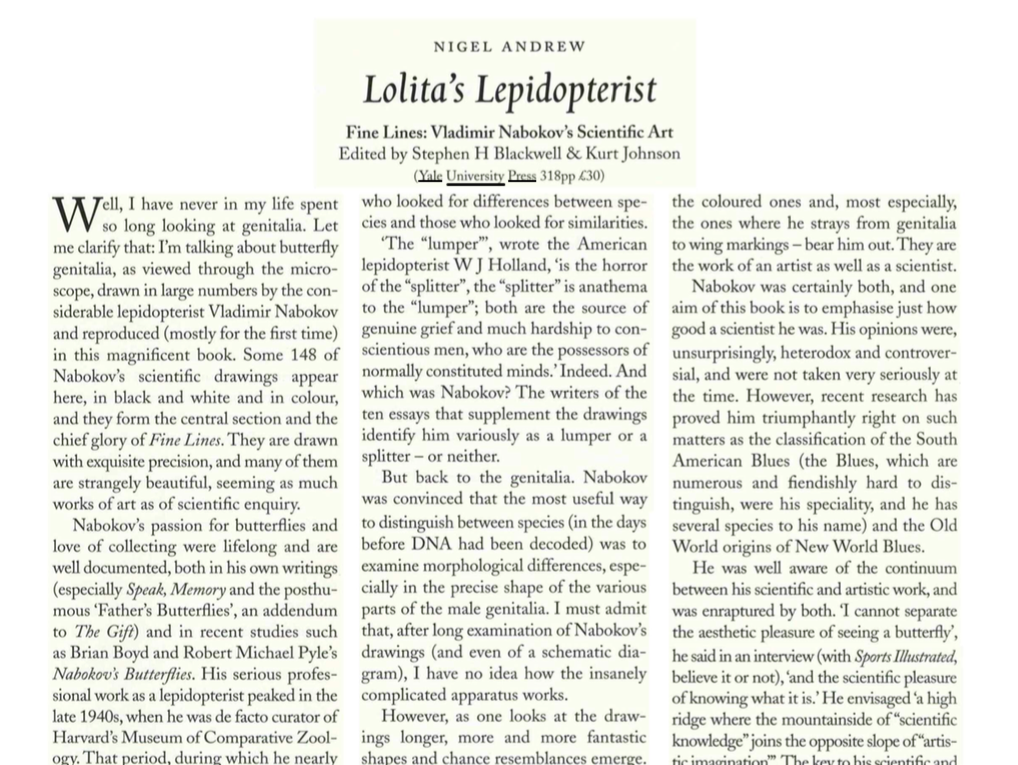
Category Archives: 2015 Press: reviews / interviews / features
Fine Lines in Vogue

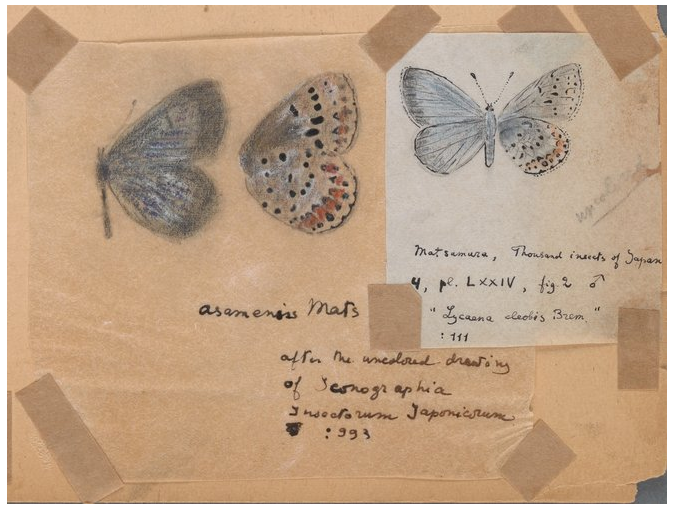
Smithsonian Magazine reviews Fine Lines
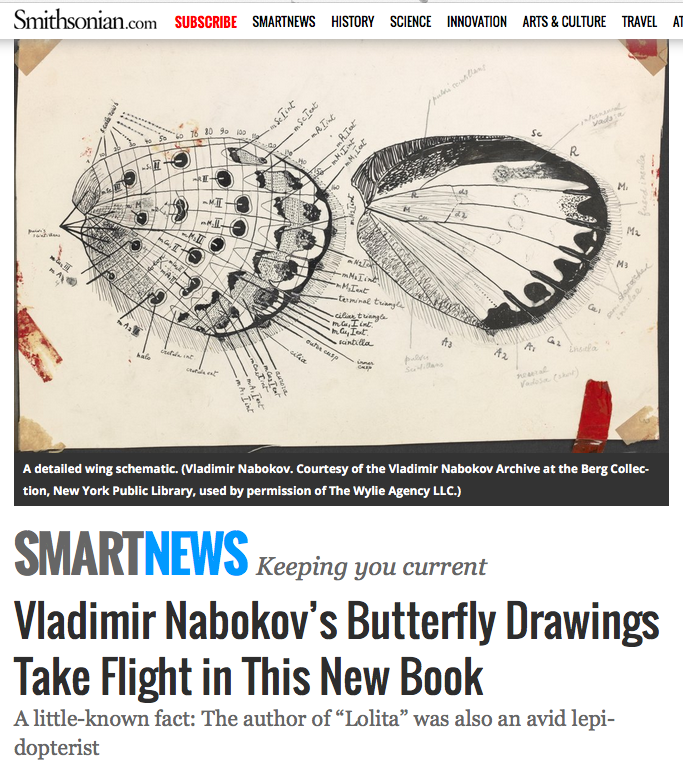
Vladimir Nabokov might be best known as a novelist, specifically as the author of Lolita, but what many might not know is that one of his deepest passions was studying butterflies.
Now, a new book from Yale University Press honors his dedication to the delicate creatures. The book, Fine Lines, is a collection of more than 150 of his scientific illustrations of butterflies, rivaling John James Audubon in their detail.
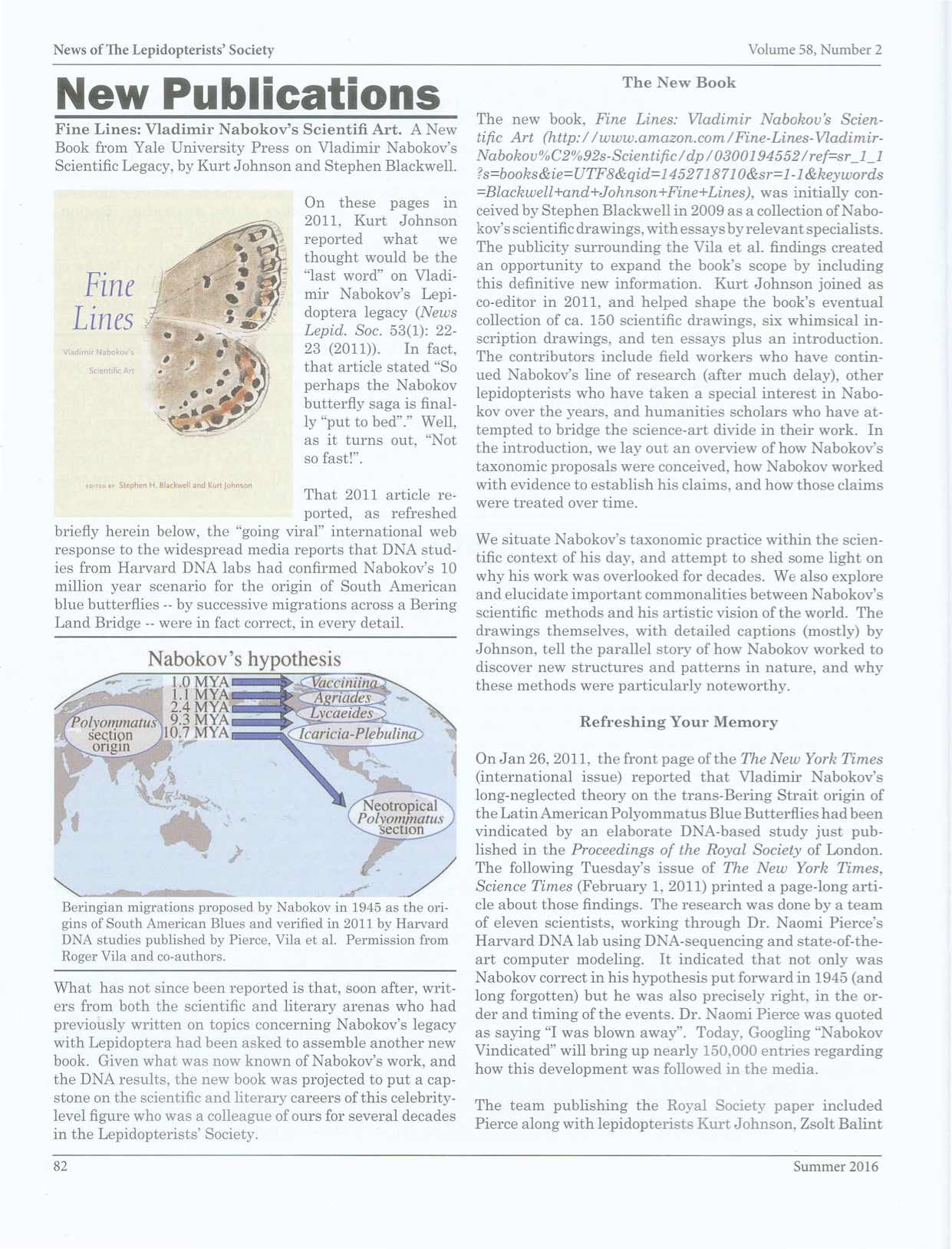
Fine Lines in The Lepidopterists’ Society News
“…The book also shed light on Nabokov’s confusing legacy with regard to mimicry…Seasoned experts on various aspects of Nabokov’s legacy weigh in on the tricky questions about his dual pursuits in science and arts. Victoria Alexander of the Dactyl Foundation addresses Nabokov’s understanding of nature in light of more current ‘post-Darwinian’ views of evolutionary processes….”


Tonstant Weader Reviews Fine Lines
 “….I also enjoyed Victoria Alexander’s Chance, Nature’s Practical Jokes, and the ‘Non-Utilitarian Delights’ of Butterfly Mimicry… While some of the science is quite technical, her writing is clear and also lyrical.” Continue reading
VN Alexander on WAMC Roundtable with Joe Donahue
 In our Ideas Matter segment we take time just about every week to check in with the state humanities councils in our 7-state region.
Today we’ll be speaking with New York Council for the Humanities Public Scholar Victoria Alexander about the relation between art and science – and the novelist and lepidopterist Vladimir Nabokov.
In addition to being a Council Public Scholar, Victoria is the Director of the Dactyl Foundation, where she facilitates interaction between artists and scientists. See more.
Locus Amoenus nominated for Dayton Literary Peace Prize
Locus Amoenus, 9/11 novel by Victoria N. Alexander, has been nominated for the 2016 Dayton Literary Peace Prize. Since 2007, the DLPP has awarded $10,000 each year. Previous recipients include, Bob Shacochis for The Woman Who Lost Her Soul, Junot Díaz for The Brief Wondrous Life of Oscar Wao, and Francine Prose for A Changed Man. The 2016 winner will be announced in September.
Locus Amoenus is now available as an audiobook, narrated by award-winning actor Ben Jorgensen, from Audible.com and iTunes. Continue reading
New Republic Reviews Fine Lines
“One of the most revealing essays in the volume is Victoria N. Alexander’s examination of the way Nabokov’s views on butterfly evolution enlivened his imagination.”

