Tag Archives: literary fiction

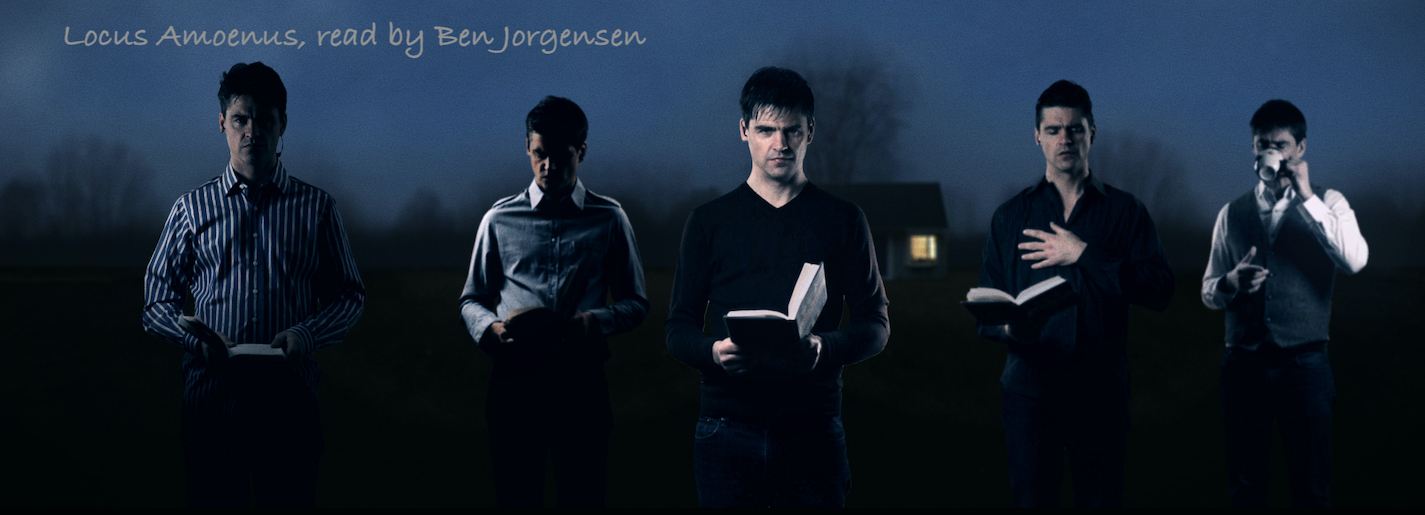
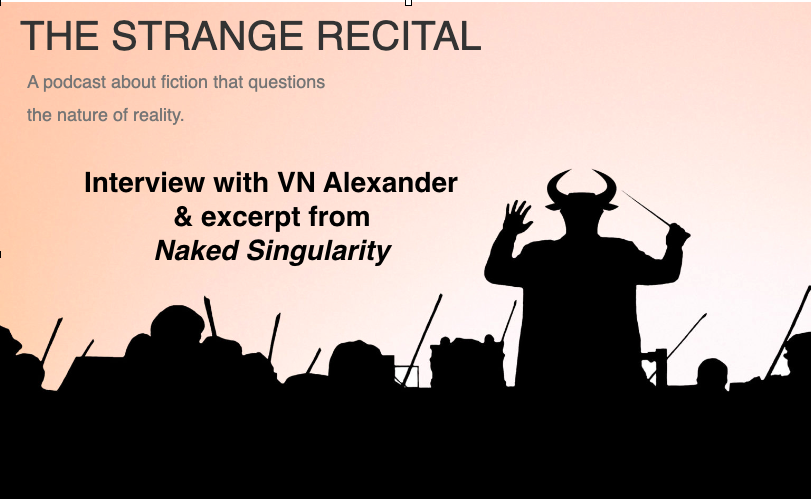
Naked Singularity on The Strange Recital

VN Alexander reads the opening of her novel Naked Singularity on The Strange Recital podcast. Afterwards she sits down to talk with hosts Brent Robison and Tom Newton.

Listen now.  Here’s snippet of the interview.

BR: I imagine most listeners will have the same question I do – how much of this story is autobiographical? And its completely acceptable if your answer is that its irrelevant because this is fiction. In fact, in the fiction arena, does so-called truth” even matter?

VA: Well, I suppose the statute of limitations has run out?  My father did die of cancer.  He did ask me to help him die. But the cast of characters is completely different. 

TN: Both of my parents have departed, and I know thats true for Brent as well. This is natural when we reach such advanced ages. Youre much younger, of course. But anyway, people disappear, the queue shuffles forward, and soon we find ourselves at the head of the line. Any thoughts about that?

VA: That’s one of the reasons losing a parent is so tough.  It says “you’re next!”  There should be lots of readers for this story.  Everyone goes through this and when they do many start obsessing about their own mortality and want to share the experiences of others.

The Girlie Playhouse to be published by Heresy Press

My mother, Tricia, circa 1977.

In the mid 1990s, I could not find a publisher for my second novel, The Girlie Playhouse, because it “promoted the politically incorrect idea that woman are mere sex objects.”  Why is it dehumanizing to women to portray them as sexually attractive? That’s an honest question.

I grew up in the suburbs of Dallas, Texas where all the women and older girls donned dresses and high heels for church on Sunday. As a teen, I was greeted by the preacher’s wife on the church steps, “Now, don’t you look pretty, young lady!”

My mother was a devout Christian. According to her own lore, she was even destined to become a nun at one point, but she was also a sexpot: her dancer’s poise, her deep voice, and her cat-eye make-up. In my earliest memories, my mother and I leapt around the living room in our underwear while Tchaichovsky’s Swan Lake blared on the stereo. It seemed it never occurred to her that being sexy could be sinful.

“God created us naked,” she once said.

Imagine my confusion when I arrived in New York City at seventeen, in my high-heels and short skirts, to attend college where I was told that I thought of myself as object not a subject, as a thing not an agent.

Like most Texan females, I actually thought of myself as strong, independent, and whip smart. As far as I was concerned, my beauty broadcast the message that I was in control of the mate selection process. It seemed to me that studying on the East Coast meant that I was going to have to learn what kind of victim I was.

Instead, to understand sexuality better, I took courses in Anthropology, Biology, and evolution. I learned about reproductive fitness and hormones.  But that didn’t quite explain taboos. I studied Religion. I read the Scarlet Letter. I learned about the Puritan revolution. I read a lot of Victorian novels about women whose lives were destroyed by pheromones.

These questions helped inspire my novel about feminine sexuality, set before the fall, as it were, in a strip club called The Girlie Playhouse, where nothing bad can ever happen, until it does. The heroine, Trixie, is inspired by my mother and the novel is dedicated to her.

Academic fashions change and in the last several years, the same professors who had shamed me for dressing “like a prostitute” began to praise transwomen traipsing around in stilettos and pole-dancing for pre-schoolers. Apparently, feminine sexuality is okay when people assigned male at birth express it.

Have we finally gotten over our biases against feminine sexuality? Or did this sudden reversal reveal the covert misogyny that energized the many waves of feminism in the 1990s?

The Girlie Playhouse has finally found a home at Heresy Press, which is dedicated to “unbounded creativity and fearless expression.” Publication date is April 2026. That’s a long time away so, but you can pre-order now from Amazon or Barnes & Noble.
2016 Top 20: Fine Lines: Vladimir Nabokov’s Scientific Art

The Book/Arts blog of the prestigious journal Nature has included Fine Lines in its top 20 book list for 2016.

natureblog


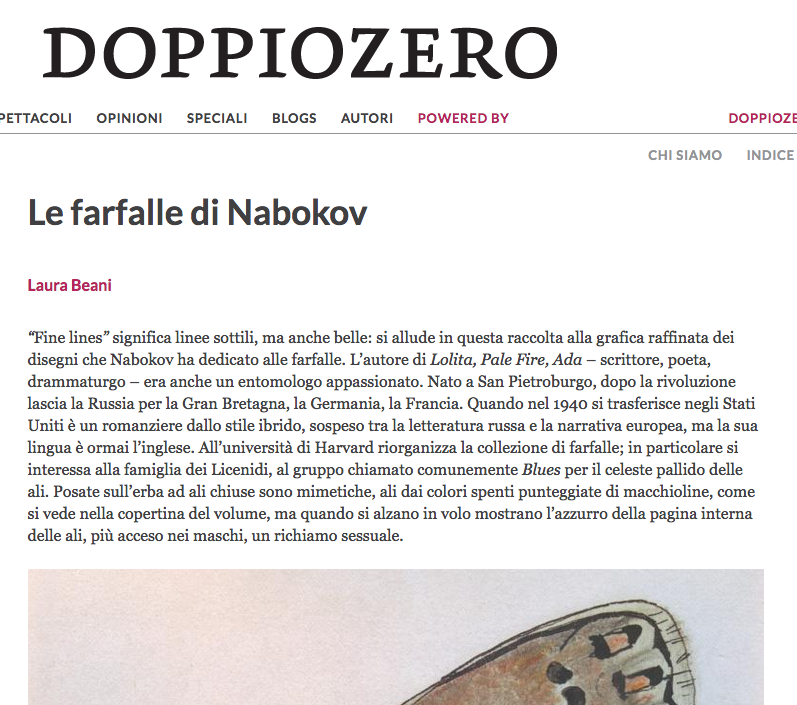
Fine Lines was also review in Doppiozero in Italy, Haibun in Romania, and science and art blog, and made the top 20 list bioteaching.com

doppiozero


haibunscienceandart

bioteaching


Fine Lines in The Lepidopterists’ Society News

“…The book also shed light on Nabokov’s confusing legacy with regard to mimicry…Seasoned experts on various aspects of Nabokov’s legacy weigh in on the tricky questions about his dual pursuits in science and arts.  Victoria Alexander of the Dactyl Foundation addresses Nabokov’s understanding of nature in light of more current ‘post-Darwinian’ views of evolutionary processes….”

nab rev003 copy


A teleological tale

As the new millennium began, I, bravely or naïvely, committed myself to this discredited branch of philosophy, officially submitting “teleological narratives” as my dissertation topic. Although I was working on a doctorate in English at City University New York  (CUNY) Graduate School, I needed a scientific advisor on my dissertation committee because teleology and biological self-organization are so entwined. Continue reading

Purpose, biosemiotics and the complexity sciences

Telos is otherwise known as final cause, one of four causes identified by Aristotle’s natural philosophy: Material cause describes how the physical properties of matter determine what a thing is and how it will react with other things. For example, an ivory ball will roll differently than a wooden ball, as the density and weight of the material determines how much resistance it has. Efficient cause describes how the agent (person, animal, or even a moving object like a billiard ball) acting on something determines what happens. For example, the pool player, the cue stick or ball hitting another ball at rest is the efficient cause of the latter’s moving. Formal cause describes how the “blueprint” or the natural laws of form determine what can be. Some forms are physically impossible; others are very probable. Experienced pool players have learned that certain types of moves can be expected to result in certain types of outcomes, and they may apply their knowledge of geometry to their game.  Final cause describes how the “end,” or the function something ultimately serves, determines what happens or how something develops. The ball was struck so that the pool player might win the game and further develop his abilities and reputation. Continue reading