Author Archives: VN Alexander

Message without a Sender

Once again, the masters of The Strange Recital podcast, Brent Robison and Tom Newton have brought my short stories to life.  In this episode I read two, “The Narrative” and “Signs and Symbols,” from a collection that I’ve been working on called Chance that Mimics choice. Like the other stories in this collection, these are about the art of making/finding meaning.

Why do writers write? Why do readers love to read?  If you’ve ever wondered why people might enjoy fiction so much that they spend the better part of their waking hours engaged in it, listen to this podcast and the interview that follows.  There is no greater pleasure for this writer than being able to sit and chat with other writers, like Brent and Tom, about writing. It’s the only kind of reward I need.

Listen to find out what a “message without a sender” might be.

You can also listen on Spotify.  Just search “The Strange Recital.”


Is counting things always more “objective”?

Social science researchers employ so-called qualitative methods, such as case studies, interviews, documentary evidence, participant observation, and the quasi-quantitative method of survey research. Physical science researchers employ quantitative methods; they take measurements, collect and count data points, and formulate equations that model how systems change. The difference in methods is said to make the social sciences more subjective compared to the hard sciences. Interdisciplinary studies departments worldwide now offer courses combining quantitative and qualitative methods as a compromise intended to resist the privileging of one method over the other. In this talk, I will argue that we’ve been coming up with answers to the wrong question. Continue reading →

Free Range Humans

In my latest paper, “Free-Range Humans: Permaculture Farming as a Biosemiosic Model for Political Organization,” I apply the lessons of my field to governance and economics.  The title is a mouthful, I know, but it’s actually a pretty accessible read. I offer this as an alternative to the Great Reset, which proposes to centralize all assets under the control of a Corporate State and, essentially, make us into livestock. 

Abstract: Modern agricultural approaches attempt to substitute biological self-reinforcing networks, which naturally sustain healthy food economies, with technology that seeks to control nature — not work with it. Artificial solutions (caging, pesticides, genetic engineering) tend to address symptoms of problems that the artificial approach has itself created. The great error of modern agriculture is the assumption that Nature is not intelligent. In fact, we can learn much from natural smart technologies that far out-perform recently invented artificial “smart” technologies. These lessons can also be applied to other political and economic systems, allowing self-organization to foster creativity and intelligence in the populace at large.

Download PDF.


Slime Mold is Smarter than AI

The Next Rembrandt is a multi-million dollar project, funded in part by a Big Bank and Microsoft, which trained AI to mimic the style of the great master in order to paint a mediocre original painting (left). In this article,  J. Augustus Bacigalupi, Òscar Castro Garcia and I show how complex and sophisticated even the most primitive forms of life are as they sense and respond to their worlds.  Artificial Intelligence, in comparison, is slow-witted, boring, and completely unable to get puns or jokes, much less to make art. We caution against anyone who might argue that current AI can begin to replace human judgement in, for instance, medicine or education.  We also offer a means by which machine sensors might be designed so that they are a little bit closer the abilities of slime mold. Click to download: Living systems are smarter bots: Slime mold semiosis versus AI symbol manipulation

Continue reading →

Alternative Local Currency: Hudson Valley Currents

I have long been interested in monetary policy in general and local alternative currencies in particular.   In Locus Amoenus (2015) I wrote about an imaginary community in upstate New York that created an alternative economic system.  As I begin to write part 2 of the Locus Amoenus narrative, I note with pleasure how life imitates art: such a community now has started in the Hudson Valley. Continue reading →

Hudson Valley News

It’s news in Amenia when a local novelist starts thinking about writing.  Over salads at Four Brothers Pizza in Amenia, I chatted with fellow novelist, Steve Hopkins, about my plans to continue the story line of my 2015 novel, Locus Amoenus. That book is a satire about a 9/11 widow who remarries and her son Hamlet becomes depressed.  You get the idea.  I think of the new work as a Hamlet Part 2, or possibly Covid-1984, or Covid 9/11, or some other such satire in the posthumous style.

Seeing my plans in print, I’m committed now to writing it. In fact, the work has begun. Thank you, Steve, for getting me started.

George Orwell’s works seems rather too relevant these days.  But his Winston Smith is unlikable, without wit or irony. He is not funny.  This tragedy needs some dark humor. And a happy ending.

See Covid-1984, The Musical.


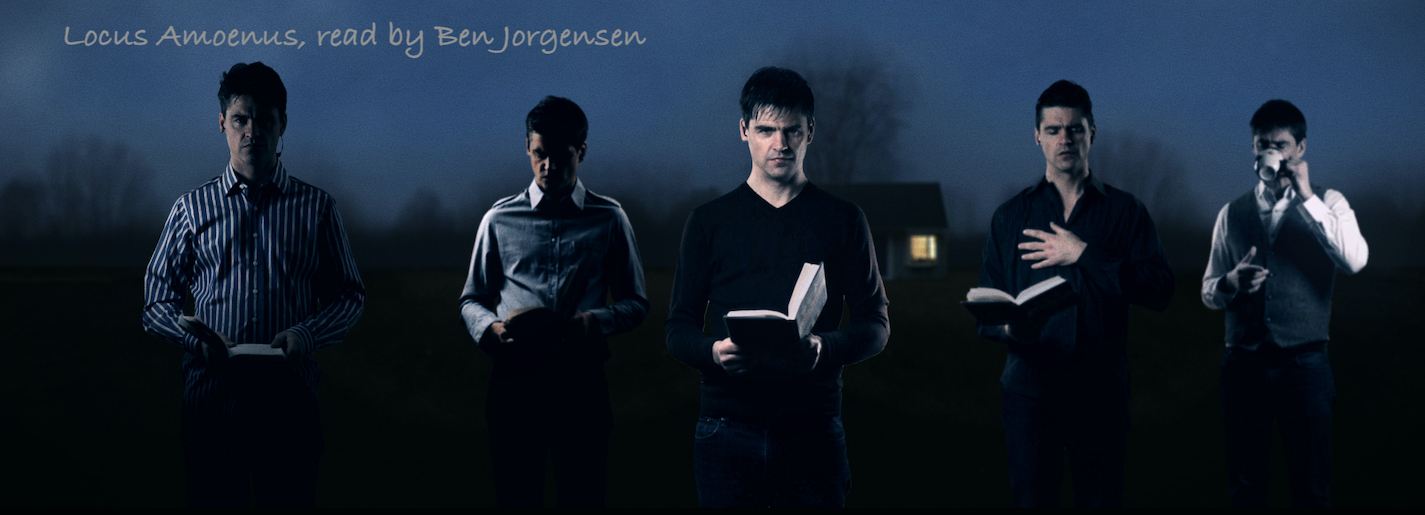
Strange Recital podcast features Chapter One of Locus Amoenus

This month the Strange Recital features Ben Jorgensen reading Chapter One of Locus Amoenus. Following the reading, the show hosts, Tom and Brent, interview Victoria Alexander about writing that novel and working on the sequel.

“As you drive northeast through Dutchess County in upstate New York, farm scenes strike calendar poses: leaning barns, well-tended white Victorians, winding roads tunneling through overhanging maples.”

A pastoral paradise… but is there something dark under the surface? Troubles in America manifest in the personal. Let Hamlet tell you about it.

Hamlet Blues by Ben Jörgensen

Goodbye to my dear friend, brilliant actor, crazy good memoirist. He said it was dangerous to play the part of Hamlet, but he had to.

I posted yesterday about my friend Ben’s death and deleted it later because it was up for awhile and didn’t get any likes. So goes our virtual existence now. The shredded fabric of society hangs in tatters. We don’t see or hear from a friend from months but we don’t notice because we don’t hear from a lot of friends who have succumbed to the isolation and fear.

I forget the timeline, but it was probably 2015 when Ben went to Australia to his family home Montsalvat to try to recover from an Adderall addiction and deal with his depression. He played piano regularly in the Elsinore-like stone halls. If I believed in ghosts, I’d say that’s where he is now singing the Hamlet Blues. He went into hospital to heal his body, but to heal his mind he later went into a studio where he recorded this song at night and my novel Locus Amoenus, playing the part of my 21st century Hamlet as a kind of therapy. He said it saved him, doing that. He said he knew that actors who played Hamlet had an uncanny tendency to end up dying by self-slaughter. But, as you can hear in the sung rendition of the famous soliloquy, Ben had worked through the depression and he was very much alive. Continue reading →

Chance the Mimics Choice published in Pangyus

I’ve working on a collection of short stories and essays about artistic creation entitled after a line from Nabokov, “chance that mimics choice, the flaw that looks like a flower.” The introduction to the collection describes my work as a philosopher of science and literary fiction author and how these two parts of my life are seamlessly interwoven.  This month the online and print journal Pangyus offers the introduction in their science section.

My work in science and art has been inspired by Nabokov and the volume will include several Nabokovian stories and essays about Nabokov’s work in lepidoptery. My science is also inspired by Alan Turing, who provided some theories about butterfly wing pattern development that I’ve used in my work on Nabokov’s theory of the evolution of mimicry, and I also need to mention Goethe, who, as the quintessential artist-scientist, plays an important role in all this too. The last story in the volume is a Faustian tale about Turing with Nabokov making a cameo appearance.

I hope you enjoy this piece.