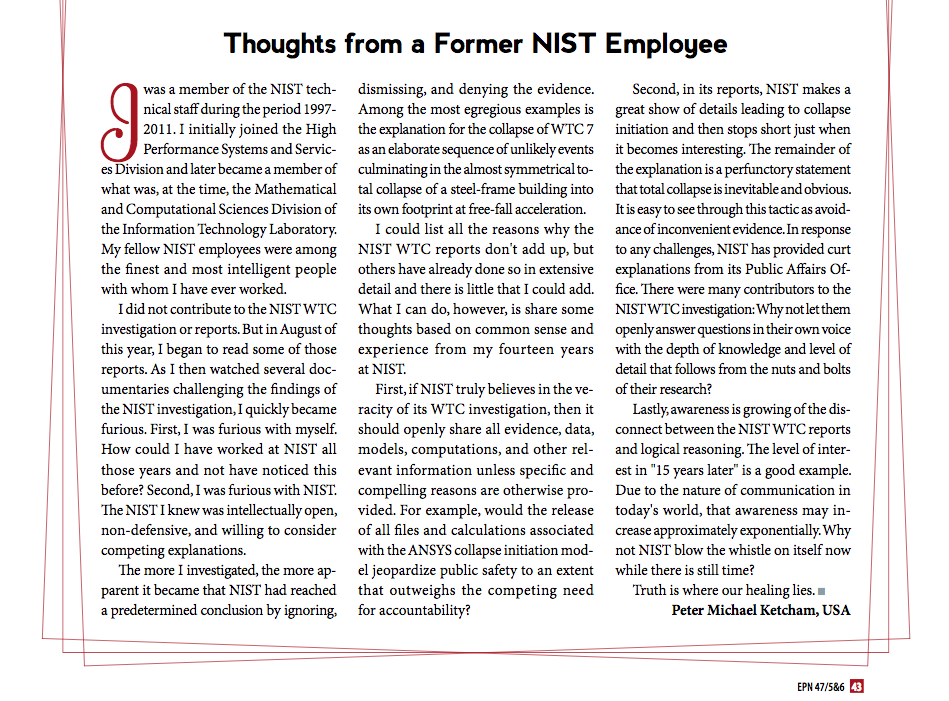
 A former employee of the National Institute of Standards and Technology (NIST), Peter Michael Ketcham, who worked at NIST from 1997 until 2011, wrote this letter (below) to the editor of Europhysics News ; NIST is the government agency tasked with investigating how the Twin Towers collapsed. Ketcham is calling NIST out for its failure to, well, investigate the collapse. (They only estimated the airplane damage and did not theorize how such damage could cause the buildings to fall.) I use the NIST report in Locus Amoenus, where one of its author’s admits, to himself, it is, “nothing but fermented blend of preconception and irrelevance.” My hero Hamlet (whose father died on 9/11 and whose new stepfather it is who works for NIST) is furious when he discovers the fraud, furious with himself, his stepfather and his mother, with everybody for being so intellectual lazy. Here is Ketcham’s reaction, which seems to echo his literary predecessor:
“First, I was furious with myself. How could I have worked at NIST all those years and not have noticed this before? Second, I was furious with NIST. The NIST I knew was intellectually open, non-defensive, and willing to consider competing explanations. The more I investigated, the more apparent it became that NIST had reached a predetermined conclusion by ignoring, dismissing, and denying the evidence…. In its reports, NIST makes a great show of details leading to collapse initiation and then stops short just when it becomes interesting. The remainder of the explanation is a perfunctory statement that total collapse is inevitable and obvious. It is easy to see through this tactic of avoidance of inconvenient evidence.”
Thanks to Ketcham for saying what needs to be said. It’s all unraveling little by little. Keep tugging at the loose threads.